Showing posts with label Gita Wisdom. Show all posts

Tuesday, 14 July 2015

Chaitanya Charan Das Based on Bhagavad Gita Chapter 04.

Chaitanya Charan Das Based on Bhagavad Gita Chapter 04.
When we are watching TV and suddenly the image and sound goes off, we may presume that the problem is in transmission. But if we find that our neighbor’s TV is still working well, then we understand the problem is not in transmission, but in reception.
The process of disseminating scriptural knowledge is something like TV transmission. At the dawn of creation or at other cosmically consequential moments, Krishna transmits the current of wisdom to exalted spiritual seers who transmit it down through a lineage of similarly exalted spiritual seers. These seers receive that wisdom not just in head but also in their heart, thereby becoming linked in a bond of love with their teachers and ultimately the original and supreme teacher Krishna. Such seers internalize, exemplify and share that wisdom with others, thus continuing the transmission. The Bhagavad-gita (04.01-02) points to such transcendental transmission of wisdom, but then cautions that the wisdom in the course of time tends to gets lost (04.03). Yet time itself is not the cause of the interruption, for Krishna states in the same verse that he is going to restore the transmission at that very time.
The problem is in the reception. The Gita (04.10) lists the reception blockers: attachment (“I don’t care about this spiritual stuff; I want to enjoy here-and-now”), apprehension (“I don’t know what’s out there; how can I court the danger of exploring?”) and anger (“Different people have different philosophies – who knows what’s right? Best to forget this whole spiritual business.”) Even if we aren’t getting reception, the transmission continues and transforms, as demonstrated through the examples of many successful seekers (04.10).

By continuing to study scripture in saintly and learned association, we can remove the reception-blockers and gradually relish Krishna’s wisdom and its culmination: eternal ecstatic love.

Tuesday, 7 July 2015

Chaitanya Charan Das Based on Bhagavad Gita Chapter 11

The natural is not necessarily desirable by Chaitanya Charan Das Based on Bhagavad Gita Chapter 11
The Bhagavad-gita (11.29) while describing how the warriors on the Kurukshetra battlefield were doomed compares some of them to moths rushing towards fire. Commentators explain that through this example of volitional self-destruction, the Gita points to warriors like the evil Duryodhana who brought about their own destruction by their depravity. The Gita (11.28) contrasts them with warriors like Bhishma who were circumstantially pushed into the war such reluctant warriors were like rivers that are pushed towards an ocean by the higher forces of nature.
Of course, some people may argue that the moths too were acting naturally their nature impelled them towards the fire. Such arguers had predecessors even at the time of the Mahabharata. During the peace negotiations before the war, Duryodhana, when reproached for his depravity, countered that he was simply acting according to his own nature: When the Creator had given him his nature, what was his fault?
The moth doesn’t have the intelligence to recognize the disastrous consequences of its attraction to fire. But we have the intelligence to foresee such consequences of giving in to our lower nature.
The fault with this argument is that the Creator has also given us scripture which educates us that we humans have a dual nature: a higher nobler nature coming from our spiritual essence and a lower baser nature coming from our psychophysical mechanism with its many past impressions. Further, the Creator has given us the intelligence to understand that we should choose and strengthen our higher nature, for it will bring out the best within us. And we should reject and weaken our lower nature, for it will bring out the worst within us.
The moth doesn’t have the intelligence to recognize the disastrous consequences of its attraction to fire. But we have the intelligence to foresee such consequences of giving in to our lower nature. By learning from scripture, we can avoid falling for the “natural equals desirable” sophistry and train our intelligence to make healthy choices, thereby promoting our ultimate good.


Tuesday, 2 June 2015

Chaitanya Charan Das Based on Bhagavad Gita Chapter 16

Courage centers not on standing up to others but on staying true to your self by Chaitanya Charan Das Based on Bhagavad Gita Chapter 16
When a principled person stands up to a powerful person, especially when that powerful person is autocratic or atrocious, then that act of standing up is often seen as courageous – and rightly so.
Still, it’s important to not reduce courage only to standing up to outside forces. Such an externalized conception of courage can make people glamorize rebellion against any authority for any cause – they may end up embracing rebellion for rebellion’s sake.
So we need to complement the external conception of courage with its internal essential counterpart. Inner courage centers on standing up to the inner forces that impede us in living according to principles. Gita wisdom explains the best principles to live for and the inner forces that impede us. We are at our core souls who can find lasting fulfillment in loving the supreme person Krishna and in loving all living beings in relationship with him. Such spiritual love is the noblest principle that we can live for. In living for such selfless love, we stay true to ourselves.
But we are often obstructed and frustrated in our attempts to live true to ourselves by the formidable inner force of the mind. The mind can act as an arbitrary autocrat who makes us do atrocious things. To stand up to this inner tyrant, we need courage. The Bhagavad-gita (16.01) points to this inner dimension of courage when in its list of the qualities that characterize the godly it follows courage immediately with purification.
In fact, as compared to the courage needed for standing up to external dictators, the courage needed to stand up to the mind is much greater. And the rewards of such courage are also far greater: the manifestation of our potential for pure love and everlasting happiness.


Tuesday, 9 December 2014

The heart of knowledge is the knowledge of the heart by Chaitanya Charan Das Based on Bhagavad Gita Chapter 18.

Towards the end of the Bhagavad-gita (18.64), Krishna announces that he will share the most confidential knowledge (sarva guhyatama).
Confidential knowledge (guhya) refers to the knowledge of our actual identity as souls, knowledge that is unknown to most people. Krishna shares this knowledge in the Gita’s second chapter.
More confidential knowledge (guhya-tara) refers to the knowledge of the various processes for realizing the soul. This knowledge is more confidential because proper processes for self-realization are known only to a few among those who know about the soul. Krishna shares this knowledge from the second to the eighteenth chapters.
The most confidential knowledge is the knowledge of the best path for self-realization, bhakti-yoga. Krishna, after having shared it earlier, especially in the ninth chapter, emphatically repeats it in the Gita’s next two verses (18.65-66). Why is this knowledge the most confidential?
Let’s consider three reasons.
 Bhakti-yoga infuses our spiritual quest with the energy of love, our heart’s strongest and purest emotion, and the even greater energy of Krishna’s omnipotent mercy.
Firstly, it activates the innermost core of our being, the heart, which in its pure state expresses the divine emotions of the soul. In the pursuit of transcendence, karma-yoga engages primarily the body; jnana-yoga, primarily the intelligence; and dhyana-yoga, primarily the mind. But bhakti-yoga, by triggering the heart’s latent transcendental emotions, engages our entire being, because body, mind and intelligence all ultimately follow the heart.
Secondly, bhakti-yoga takes us beyond the impersonal Brahman and the neutral Supersoul to the all-loving Supreme Person, Krishna – the rarely realized zenith of transcendence.
Thirdly, bhakti-yoga stimulates the innermost human and divine emotions. It infuses our spiritual quest with the energy of love, our heart’s strongest and purest emotion, and the even greater energy of Krishna’s omnipotent mercy.

Thus the heart of knowledge – the most confidential knowledge – is the knowledge of the heart, the knowledge of establishing the most intense heart-to-heart connection between the human heart and the divine heart.

Saturday, 8 November 2014

When the mind becomes peaceful, we become joyful by Chaitanya Charan Das Based on Bhagavad Gita

Seekers sometimes ask, “Bhakti is supposed to be joyful. But I don’t get much joy in it. Why is that?”
Because the mind interrupts our practice of bhakti. Suppose we are drinking a glass of delicious juice and someone suddenly turns our face away from the glass. Naturally, we won’t taste the juice.
The mind does something similar with us. The joyfulness of bhakti centers on remembering and relishing the sweetness of Krishna in a mood of selfless devotion. The receptacle for receiving the nectarean remembrance of Krishna is our consciousness. The more our consciousness is receptive and attentive to Krishna, the more we relish his beauty. Unfortunately however, the mind being filled with dreams and schemes for mundane pleasures distracts us away from Krishna towards worldly objects.
Even when we don’t relish devotional fulfillment consciously, the endeavor to connect with him works subconsciously, attracting his mercy and purifying the mind of its worldly obsessions.
When we give in to the mind’s distractions and indulge in worldly pleasures, we naturally miss the nectar-flow of devotion. Even if we don’t indulge physically, the inner battle to resist the distraction drains us. And this battle often becomes more intense when we try to focus on Krishna through directly devotional activities such as mantra meditation. That’s why such activities sometimes seem exhausting, not energizing.
Nonetheless, if we keep striving to connect with Krishna, some drops of his nectarean remembrance do occasionally trickle into our consciousness, giving us extraordinary devotional fulfillment. Even when we don’t relish such fulfillment consciously, the endeavor to connect with him works subconsciously, attracting his mercy and purifying the mind of its worldly obsessions. It then realizes that remembering Krishna is far more fulfilling than any of the worldly indulgences it had imagined to be pleasurable. Consequently, it gives up pursuing those pleasures and joins us in relishing the sweetness of Krishna. When the mind thus becomes peaceful, theBhagavad-gita (06.27) indicates that we become joyful, supremely joyful.


Monday, 20 October 2014

Restraint is not repression – it is the roadway to real expression by Chaitanya Charan Das Based on Bhagavad Gita

Many people champion self-expression and deride restraint as repression.
But is it really repressive?
Consider musicians wanting to express themselves. Do they go on stage without preparation? If they do, what will come out will be nowhere near their best self – it will be a pale shadow. Musicians who excel at extempore performance have spent long hours in meticulous training. And what is such training if not restraint? It involves careful churning of one’s musical instincts to repress the unwholesome instincts and express the wholesome ones.
Whenever we allow uncensored self-expression, what usually comes out is our lower self.
This principle of screening applies for all forms of self-expression. Gita wisdom explains that our real self is much deeper than just some artistic or similar aspect of our self. Our essential self is spiritual – we are pure souls, reservoirs of glorious qualities, and parts of all-pure Krishna. But the way to that self is blocked by a lower self, which is primarily the mind running according to the default program created by our past indulgences. This lower self often imagines the basest indulgences to be the most enjoyable. And because we have pandered to the lower self for a long time in this and previous lives, it is frequently swifter than our authentic self. So whenever we allow uncensored self-expression, what usually comes out is our lower self, which makes us behave worse than our normal self, leave alone our best self.
Restraining ourselves according to scripture, as the Bhagavad-gita (02.64) recommends, enables us to firstly check which self is expressing itself and secondly kindle the expression of our authentic self, thereby bringing out our best. Such spiritual self-expression, by propelling us towards life eternal with Krishna, brings real freedom and lasting fulfillment, which is what champions of self-expression actually long for.
Thus restraint far from being repressive paves the way to authentic self-expression.


Friday, 17 October 2014

To grow through problems, go beyond the circumstantial to the existential by Chaitanya Charan Das Based on Bhagavad Gita Chapter 01

“What should I do now?” When we face this question, we usually answer based on practical concerns. But when confronting dilemmas that have no practical solutions, we are forced to either become frustrated or look beyond the circumstantial to the existential, asking questions about the very nature and purpose of our existence.  We realize we can’t answer the question “What should I do?” without confronting the question “Who am I?”
At the start of the Bhagavad-gita, Arjuna faced a circumstantial dilemma that had no practical answers. He found himself torn between two courses of action. “If I am a warrior, then my duty (kshatriya-dharma) is to fight for a righteous cause, whoever be my opponent. But if I am a member of the Kuru dynasty, then my duty (kula-dharma) is to avoid shedding the blood of my family members, whatever the price.” He found neither option acceptable and felt himself trapped in a lose-lose situation, as the Gita (01.30) depicts.
Krishna didn’t offer Arjuna any pat answers, but changed his frame of reference by revealing the deepest dimension of his existential identity – as a soul. And the dharma of every soul is to love and serve Krishna. As Krishna is the greatest well-wisher of everyone, doing his will enabled Arjuna to do the best for everyone involved.
When we face intractable circumstantial dilemmas, we too can turn towards Krishna by prayerfully seeking guidance and submissively opening our heart to him. With this devotional disposition, the Gita (10.10) assures that we will get the intelligence about how to best serve amidst life’s perplexities. Such intelligence will resolve not just our circumstantial crisis, but also our existential crisis by stimulating deeper realization of our eternal spiritual identity, which is for all of life’s perplexities the only ultimate solution.


Wednesday, 15 October 2014

The impersonal stereotype of impersonalists militates against personlism by Chaitanya Charan Das

An impersonal stereotype of impersonalists refers to the notion among some neophyte personalists that all impersonalists are blasphemers of Krishna.
However, the Gita itself differentiates among impersonalists. It (09.11-12) declares that those impersonalists who minimize Krishna’s form as materia, known as Mayavadis, l are deluded and ill-fated. In contrast, it (12.03-04) indicates that those impersonalists who simply seek the impersonal Absolute, without condemning the personal, known as Brahmavadis, eventually attain their desire – but only after great labor (12.05).
Many spiritualists frequently self-identify as impersonalists not due to intention but due to misinformation.
Nowadays, most people, even those who self-identify as spiritualists, are not serious seekers. Such dilettante spiritualists usually gather their spiritual conceptions from random readings or common cultural depictions. As such sources often portray that the personal manifestation is for non-intellectual sentimentalists and the impersonal for intellectuals, these fledgling spiritualists fancy themselves as impersonalists. They don’t usually have any envy towards Krishna’s personal form – to the contrary, they may even have some devotion for him. They frequently self-identify as impersonalists not due to intention but due to misinformation.
If explained properly based on Gita wisdom how the highest manifestation of the Absolute Truth is personal, such spiritualists often become personalists. We ourselves may have been such nominal impersonalists before our spiritual mentors rescued us from our misconceptions.
If we are to be similarly considerate in helping other nominal impersonalists, we need to avoid stereotyping them as blasphemers. Such stereotyping actually militates against our own philosophy. After all, personalism holds that not only Krishna but also all living beings are persons. So impersonalists are not a homogenous collective of blasphemy – they are distinct persons with individual conceptions and aspirations. By not judgmentally condemning them all as blasphemers but by cautiously yet open-mindedly offering them on a case-to-case basis opportunity for spiritual elevation, we honor our personalist philosophy and also reflect the compassionate desire of our personal Lord to benedict everyone, even impersonalists.


Tuesday, 14 October 2014

The best translation of the Gita is its translation into life by Chaitanya Charan DasBased on Bhagavad Gita Chapter 04

People interested in the Bhagavad-gita sometimes ask, “Which is its best translation?”
The best translation is its translation into life. That is, the Gita’s best translation will come from those who live it in their lives.
Mastery over a language doesn’t automatically imply mastery over everything written in that language. Just as English expertise alone wouldn’t qualify one to explain an English book on advanced quantum physics, so too Sanskrit expertise alone doesn’t qualify one to explain a Sanskrit book on advanced philosophy: the Gita.
The Gita is a book for healing – healing the human heart from the wound caused by its fracture from the divine heart.
What makes linguistic mastery further inadequate is that the Gita is not a theoretical book for abstract analysis; it is an action-calling book for practical living. It is a book for healing – healing the human heart from the wound caused by its fracture from the divine heart. This healing can fulfill forever our longing for love and happiness. For such healing, the Gita endorses bhakti-yoga as the best process.
In fact, the Gita (04.03)
declares that devotion is the qualification for comprehending its message. To access its healing wisdom, we need to learn it from the great bhakti exponents who are themselves healed and have healed others.
Suppose an ancient Chinese medical book that contains cures for many deadly diseases was available in two English translations: one by a linguist adept in both Chinese and English and one by a doctor with a basic grasp of both languages who has practiced that medicine for decades and healed thousands.
Which translation would we choose?

If we were interested in its medical insights, we would choose the doctor’s translation. Similarly, if we wish to go beyond linguistic technicalities to the Gita’s life-transforming potencies, then the translation by those who have translated the Gita into their lives and the lives of others would be the best translation.


Monday, 13 October 2014

The defect of dallying with the mind is that it makes the dallier a defector

We are all in an inner war with the mind, which the Bhagavad-gita (06.06) indicates is often our enemy. In this war, scriptural rules that mandate regulation of worldly indulgence are our protectors. When immoral temptations masquerading as pleasures seduce us, rules serve as fences that keep us within the safe zone of scripturally ordained morality.
Degraded and demoralized, we then begin the slow labored journey back to the protection of the fences that we had ourselves broken down.
Dallying with the mind refers to letting our thoughts idly wander, unguardedly allowing them to go wherever the mind fancies. When we dally thus, the mind beguiles us into believing that many pleasures await us if we just step out of the fences of morality. As we fall for this lie, the mind subtly and sinisterly distorts our perception so that we see it not as an enemy, but as a friend. And we see scriptural rules not as protectors, but as deprivers.
By thus perverting our perceptions, the mind makes us defectors, who fight against the very principles we had resolved to uphold. Infatuated by the mind’s promises of pleasure, we break the protective moral fences and become its puppets, doing things that we would normally never do. Only when we experience the hollowness of its promised pleasures do we realize that we have been fooled. Degraded and demoralized, we then begin the slow labored journey back to the protection of the fences that we had ourselves broken down.

If we don’t want to become defectors, we need to stop dallying with the mind. By keeping ourselves busy in Krishna’s service, we can leave ourselves no time to dally with the mind. Over time, as our devotion develops we will become free from any need for such dallying, for we will delight in dallying with Krishna, in relishing constantly his presence invoked by our sincere devotional service.
http://www.gitadaily.com

Monday, 6 October 2014

The soul is metaphysical, but not metaphorical by Chaitanya Charan Das Based on Bhagavad Gita

The idea of a soul is found in the metaphysical ruminations of almost all traditions. But few traditions explain clearly what the soul is. They frequently use the term as a metaphorical reference to our non-material essence.
Such metaphorical usages often extend to the essence of anything. For example, ‘the soul of Japan was shattered by the atom bomb attacks.’ Usages like these are not semantically wrong. But when coupled with the prevailing fuzziness about the notion of the soul, they tend to reduce the soul to a metaphor. It then becomes all too easy for materialists to banish the soul into non-existence, leaving occasional references to it ontologically meaningless.
That the soul is beyond fragmentation, incineration, dissolution and desiccation emphasizes the ontological actuality of the soul.
Such degeneration to meaninglessness is graphically illustrated in the phrase ‘the soul of materialism’ used by some materialist philosophers. Materialism’s central dogma is that matter is the only thing that exists; so the soul being non-material doesn’t exist. Therefore, the phrase ‘the soul of materialism’ makes sense only when the usage ‘soul’ is stripped of all ontological import.
Gita wisdom pre-empts such fuzziness and meaninglessness by explaining that the soul is a concrete higher-dimensional entity, a being that animates the body with consciousness. Its assertion (02.24) that the soul is beyond fragmentation, incineration, dissolution and desiccation emphasizes this ontological actuality of the soul.
How?
Breaking, burning, dissolving and drying – these apply to things that really exist. By applying them to the soul, the Gita communicates that the soul is just as real. And by simultaneously asserting that the soul is not destroyed by the actions that destroy physical things, it conveys that the soul exists at a level higher than the physical – the metaphysical level.
When we grasp the reality of the soul, we infuse our quest for self-realization with clarity, gravity and urgency, thus accelerating our attainment of lasting spiritual happiness.


Sunday, 5 October 2014

Metaphysical blindness is more dangerous than physical blindness by Chaitanya Charan Das

Physical blindness makes us unaware of our surroundings, whereas metaphysical blindness makes us unaware of ourselves – our identity and our purpose. The Bhagavad-gita (15.10) indicates how the metaphysically blind can’t see their plight in material existence.
More troublingly, whereas physical blindness comes with the awareness that we are blind, metaphysical blindness frequently comes with blindness to our blindness – it couples with prevailing cultural conceptions to give us a pseudo-identity and a pseudo-purpose that makes us forget our ignorance.
 Metaphysical blindness frequently comes with blindness to our blindness.
Most troublingly, whereas physical blindness comes with the humbling recognition that we often need help to find the way, metaphysical blindness comes with an arrogant assumption that we don’t need any help from anyone. Such arrogance insidiously makes aggressive anti-theists deride seeking help from God, the source of the supreme metaphysical vision, as a sign of pitiable emotional weakness.
These differences between the two blindnesses are not just theoretical but also consequential. Whereas physical blindness may trouble us for one lifetime, metaphysical blindness makes us do misdeeds whose reactions may haunt us for many lifetimes.
Thankfully, there’s a positive side to the differences too. Whereas physical blindness may not be curable, metaphysical blindness is eminently curable. The Gita (15.12-15) guides such people towards metaphysical vision by outlining how even the material things they need for their material survival and enjoyment are sustained by a non-material essence, the arrangement of God. Even if the metaphysically blind may never read the Gita, they can unknowingly follow its thought trajectory if they introspect open-mindedly and thereby infer the existence of God.

Gita wisdom stands ready to help them all the way in their healing journey right from showing them the first rays of metaphysical light to revealing to them the full beauty and glory of existence as an arena for love with the all-attractive Supreme Person, Krishna.

Saturday, 4 October 2014

The use of force to convert doesn’t expand faith – it reduces faith By Chaitanya Charan Das

Some religious groups force others to convert to their faith, “Convert or die.”
But faith is a choice of the heart that can’t be forced. Though force may compel some to mouth a faith-pledge, that doesn’t constitute the change of heart at the heart of true faith. Brute force reduces faith from a matter of the heart to a matter of the lips.
That fanatics celebrate as religious victories converting others to such reduced faith shows that they grossly overrate the externals of their faith. Might they have never known the essence of faith: its security and sweetness? Might they be masking their inner emptiness by outer aggressiveness? Sadly, all traditions have been guilty, to greater or lesser degrees, of such superficiality.
Might fanatics be masking their inner emptiness by outer aggressiveness?
Can faith be shared while respecting people and their God-given free will? Yes, the Bhagavad-gita demonstrates how faith transmission can be respectful and successful: through education and experience.
The Gita’s narrative aims to persuade Arjuna to have faith in Krishna and do his duty. Rephrasing according to our context, Krishna wants to convert Arjuna. Yet he doesn’t resort to force, though he being God commands all the force in all of existence. Instead, he appeals to Arjuna’s reason by outlining a majestic worldview that makes faith the natural and desirable choice. And he offers Arjuna a divine experience by demonstrating his universal form. After making his case, the Gita (18.63) states that Krishna leaves Arjuna free to deliberate and decide. When Arjuna voluntarily chooses to do Krishna’s will, that choice demonstrates an authentic conversion, a triumph of faith.

The truly faithful similarly share with others scriptural wisdom to illumine their intelligence and yogic processes to help them experience the divine. Those who instead resort to force to convert simply expose their intellectual and experiential bankruptcy.

Thursday, 25 September 2014

Be not allured by the blame game or the claim game – stay focused on Krishna

Blame game usually involves pointing the blaming finger outwards to others whenever things go wrong.
The blaming finger can also point upwards or inwards. When it points upwards, we blame God for being unintelligent or uncaring or even non-existent. When it points inwards, we beat ourselves down with self-recrimination, “I am good-for-nothing,” ending up unnecessarily with inferiority complex.
To solve the problem, we need not a blaming finger, but a helping hand
Whichever way the blaming finger points, it doesn’t help in solving the problem. For that, we need not a blaming finger, but a helping hand. Krishna being forever present in our heart is always ready to offer us that hand, even when we are to blame and even when we blame him. But we don’t accept his hand because the ego keeps us seduced in playing the blame game. Even if we succeed in pushing off the blame elsewhere – and there’s no guarantee of that – still we end up having done nothing tangible to rectify the situation or to even learn from it.
When things go right, the ego makes us play the claim game, seeking all the credit. Though the claim game seems pleasant, it too disappoints. Even if we are praised for the success – and there’s no guarantee of that because others too are playing the claim game and competing for praise – still the ego is insatiable. It always finds whatever praise it gets inadequate, thereby leaving us dissatisfied.

Pertinently, the Gita (18.58) urges us to ignore the ego and instead stay focused on Krishna. If we strive to serve him to the best of our capacity, then he will guide us from within, amidst both failures and successes, to choose the best course of action. We will learn and grow from every situation, progressing steadily towards life’s ultimate success: eternal ecstatic love for Krishna.

Wednesday, 24 September 2014

Don’t just battle over your choices – choose your battles by Chaitanya Charan Das Based on Bhagavad Gita

Battling over our choices refers to struggling to make the right choice while staying in the face of temptation.
Choosing our battles refers to deciding which temptation to face and which to flee.
Suppose we have trouble resisting the temptation to access inappropriate sites on the net. Then battling over our choices would refer to having unfiltered Internet access and straining to restrict our net surfing. Choosing our battles would refer to deciding that such a battle is unnecessary and restricting our net access using an Internet filter. Such restriction is a contemporary application of
Avoiding avoidable danger is not cowardice – it is common sense.
the time-honored cultural principle of restricting free mixing between the genders to minimize the possibility of wrongdoing, accidental or intentional. The Bhagavad-gita (02.58) recommends such a safety-first approach by urging us to withdraw our senses from the sense objects, as a tortoise withdraws its limbs within its strong shell.
Of course, we can’t always choose our battles; some temptations may come upon us unavoidably, forcing us to fight against them. But in our war against temptation, more often than not, we get disheartened because we thrust ourselves into battles we don’t need to fight and then get battered.
Avoiding avoidable danger is not cowardice – it is common sense. While walking, we don’t walk in the middle of a road and struggle to evade vehicles; we walk on the footpath and do something productive, maybe converse with a friend.

From the point of spiritual productivity, we don’t grow in our devotion just by saying no to temptation; we grow by saying yes to Krishna. And we can’t say yes to him wholeheartedly if half of our heart is constantly considering the option of saying yes to temptation. Best to not leave that option open so that we can more easily choose the best option: Krishna.

Sunday, 21 September 2014

Don’t treat a game like life or life like a game

Many people treat games as if they are as important as life itself. Human culture has always featured sports as a form of recreation, but today’s culture has whipped up for spectator sports a mass mania. And this mania is not harmless – it often leads to corruption and destruction, as when people are swindled through match-fixing or when frustrated fans destroy their TV sets or tragically even commit suicide. Such suicides manifest the worst equation of a game to life – when a game is lost, life no longer seems worth living.
The suicides of sports fans manifest the worst equation of a game to life – when a game is lost, life no longer seems worth living
Conversely, many people treat life like a game. No doubt, game metaphors can illumine some aspects of life. But games have an undercurrent of frivolity that undermines the gravity of life. Essentially, life centers on attaining the fulfillment of love – we all want to love and be loved. When people reduce love (actually lust masked as love) to a game, they find pleasure only in the chase and the conquest, not in the commitment that makes relationships lasting.
The widespread equation of a game to life and life to a game represents the general distortion of perspective in today’s world. TheBhagavad-gita (18.32) states that such a topsy-turvy perspective typifies intelligence in the mode of ignorance.
Gita wisdom shows the way out of such ignorance. It informs us that by directing our love towards the all-attractive Supreme Person, Krishna, we as eternal souls can find everlasting fulfillment. Intriguingly, life in Krishna’s abode is an endless lila or love-play, wherein participants relish purely the excitement, exhilaration and enjoyment that attracts us to games.
So, if we regulate our attraction for games in this temporary world and focus on cultivating devotion in our life, we will gradually find the perfect fulfillment for our attraction to games.

Saturday, 20 September 2014

Don’t blunt the intelligence with indulgence; sharpen it with abstinence

Our intelligence is like a knife. It can cut through the surface appearance of things and see their deeper nature.
Just as a knife with rust becomes blunt, so does the intelligence covered by the rust of materialism. Such rust accumulates on the intelligence of those who engage in unrestricted material enjoyment. As they are enamored by the promises of material enjoyment, their intelligence can’t see beyond the material, as the Bhagavad-gita (02.44) indicates.
Abstinence is not the dry abnegation that saps all joy from life – it is the dynamic renunciation that increases focus on Krishna by rejecting distractors in devotion.
If materialists’ intelligence is blunted, then why do some seem to be intelligent, as in, say, making brilliant technological devices? That’s because a blunt knife has its use too – not as a cutter, though, but maybe as a hammer. So even materialists with blunted intelligence may control matter limitedly and temporarily, but they can’t transcend it. The Gita(18.30-32) classifies intelligence into the three modes, indicating thereby that intelligence can be present in the lower modes. But it also stresses that only intelligence in goodness, with its characteristic self-regulation, can know the way to liberation and the eternal happiness thereof. Such intelligence is sharp, being able to see beyond matter.

We can sharpen our intelligence by abstinence. This abstinence is not the dry abnegation that saps all joy from life – it is the dynamic renunciation that increases focus on Krishna by rejecting distractors in devotion. Without abstinence, our blunt intelligence will stay allured by worldly pleasures and won’t be able to connect with Krishna. So our experience of devotional fulfillment will remain occasional and insubstantial, as will be our spiritual growth. With abstinence, our sharp intelligence will perceive the futility of anti-devotional pleasures and the glory of devotion. By our consequent focused devotional service, what we know theoretically, we will realize experientially, thereby progressing towards increasing and lasting fulfillment.

Wednesday, 17 September 2014

Krishna doesn’t ordain evil – he just sanctions it by Chaitanya Charan Das Based on Bhagavad Gita Chapter 13

People often ask, “If God, the creator of world, is good, why does evil exist in the world?”
Evil arises not from Krishna’s omnipotence but from the soul’s independence.
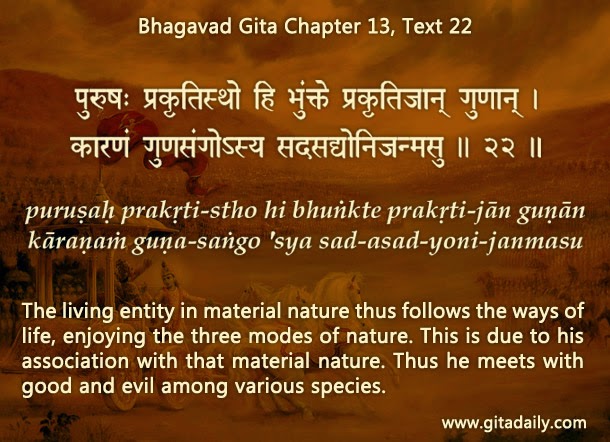
Though Krishna is omnipotent, he still gives all souls free will so that they can choose to love him and therein relish existence’s supreme fulfillment. After all, only free individuals can choose to love. But the souls can abuse their independence by choosing to not love Krishna but to enjoy matter instead. The Bhagavad-gita (13.22) indicates that due to such desires, the materially enamored souls get entrapped in matter. Impelled by material desires, the souls engage in evil deeds and are subjected to others’ evil actions, as per the inexorable law of karma.
Evil arises not from Krishna’s omnipotence but from the soul’s independence.
The next verse (13.23) underscores Krishna’s role in the souls’ actions: he is the sanctioner, not the ordainer. He doesn’t force or instruct or even want souls to get entangled in matter or to act destructively. When they choose to do wrong, he allows them to fulfill their desires till their karmic bank account runs out. Others may seem to be victimized by such destructive actions, but the victims actually reap the results of their own past karma.
Though the souls have got themselves into this arena of evil, Krishna is too compassionate to abandon them here. He accompanies them as the Supersoul in their hearts and guides them towards his loving devotion, which is the way out of all evil. Devotion empowers them to curb and counter the evil within them – their tendency to misuse their independence. It also enables them to tolerate and transcend the inevitable evil that may befall them due to their past karma. And most importantly it takes them entirely beyond the arena of evil, the material existence, to Krishna’s all-good eternal abode.


Monday, 15 September 2014

Our intelligence can be overcome by illusion, yet it is also the key to overcome illusion

To practice spiritual life means to wage an inner war against the illusion created by our lower desires, especially lust. TheBhagavad-gita (03.36-43) vividly outlines the dynamics of this inner war.
To help us focus our attack, the Gita (03.40) mentions the strategic positions captured by lust: the senses, the mind and, surprisingly, the intelligence. The statement that intelligence is a stronghold of lust is surprising because it is with the intelligence that we comprehend lust’s inimical nature and combat it. Even the Gita itself (03.43) urges us to use our intelligence to conquer lust. So is our intelligence overcome by illusion or is it the key to overcome illusion?
When illusion overruns our intelligence, we indulge in lust “intelligently”, that is, we (ab)use our intelligence to cover our tracks after indulgence so as to preserve a façade of purity.
It is both, for the intelligence lies within the conflict zone wherein the line of control keeps shifting. Sometimes the intelligence is misled by illusion and sometimes it is led by truth. When illusion overruns our intelligence, we indulge in lust “intelligently”, that is, we (ab)use our intelligence to cover our tracks after indulgence so as to preserve a façade of purity.
When our intelligence is guided by truth, especially scriptural truth, then it realizes the folly and futility of illusory indulgences. Being thus illumined, the intelligence resists and repulses the onslaughts of illusion. Of course, intelligence alone is not enough to counter illusion – we need devotion and the omnipotent grace of Krishna that devotion connects us with. Still, frequently it is intelligence that helps us realize the glory of devotion and our need for devotion. Thus intelligence is the key to overcome illusion.

Nonetheless, because our intelligence is always vulnerable to be overcome by illusion, we need to safeguard it by regularly studying Gitawisdom. Such diligent study will make our devotion steadier and our march to victory in the inner war swifter.

Friday, 12 September 2014

Without devotion, renunciation comes painfully; with devotion, even liberation comes joyfully

“To avoid karmic bondage, renounce the world.” This widespread notion governs Arjuna’s reasoning at the start of the Bhagavad-gita. However, the Gita recommends an alternative that centers not on renunciation but on devotion.
The Gita (05.06) conveys this emphatically by deeming mere renunciation of the material as painful and deeming yogic connection with the spiritual as expeditious in granting liberation. To effectively connect with the spiritual, Gita wisdom explains that the highest spiritual reality is Krishna and that the best yoga is bhakti-yoga. Why? Because bhakti-yoga spiritualizes our natural longings, instead of suppressing them, as does renunciation.
What is undesirable is not renunciation per se, but the renunciation that obsesses over rejection
What are our natural longings?
To seek happiness; to be active, doing things; to love and be loved.
Bhakti-yoga fulfills our quest for happiness through connection with the reservoir of all happiness, Krishna. Dovetailing our tendency to act, bhakti-yoga redefines our activities as forms of devotional service. It fulfills our longing for love by linking us with the supremely lovable and loving being, Krishna. Because bhakti-yoga integrates our natural longings, it is joyfully performed, as the Gita (09.02) declares. Moreover, bhakti-yoga is not just enlivening, but also rewarding, supremely rewarding – it eventually grants the ultimate liberation.
In contrast to such holistic devotion, the renunciation that denies our natural longings is unsustainable. Its price is prohibitive and its process, painful. Of course, what is undesirable is not renunciation per se, but the renunciation that obsesses over rejection. The renunciation that removes the distractions to devotion is desirable, for it accelerates the progress of devotion.
Importantly, the propeller for this progress is not renunciation, but devotion. If we focus unduly on renunciation, we will find ourselves drained and distressed. If instead we focus on serving Krishna to the best of our capacity, then by his grace, we will gradually become enlivened and liberated.