Showing posts with label Online Gita Daily. Show all posts

Monday, 30 November 2015

Don’t blame ignorantly – blame ignorance

Suppose a person suddenly falls sick and starts looking to assign blame – blaming others for transmitting that infection, blaming the doctor for not prescribing a protective health regimen, or blaming oneself for neglecting health. While seeking the disease’s origin can help, much more important is taking the treatment. Patients who get so obsessed with blaming an indeterminate cause as to neglect a reliable treatment sabotage themselves.

A similar self-sabotaging obsession can afflict our response to sudden tribulations. We may blame others, God or ourselves. All such blaming mentalities reflect ignorance. Others are ultimately instruments of our own karma. And God is like a judge who adjudicates based on our deeds.

Blaming ourselves for our past misdeeds can be psychologically damaging if the blaming triggers unhealthy guilt depression, self-flagellation and similar thought-patterns. We damage ourselves thus when we agonize over karma while remaining ignorant of our essential spiritual identity. We are souls, eternal parts of the all-pure supreme. So, whatever our misdeeds, we are essentially pure. Our purity is covered at present by ignorance, which makes us act imprudently. Ignorance misdirects not just our actions, but also our reactions – it makes us react to problems by agonizing over causes instead of seeking relief in spiritual wisdom. The Gita (05.15) stresses that ignorance is what deludes the living being. Blaming ignorance doesn’t mean washing off responsibility for our misdeeds; it means distancing ourselves intellectually and emotionally from the alien contamination that makes us violate our natural spiritual purity and integrity.


Bhakti-yoga counters ignorance most efficaciously by invoking the presence of the all-pure, all-enlightened supreme. His inner presence comprises a protective shield against ignorance and kindles our latent inner awareness. The more we act in spiritual light, in a mood of service to Krishna, the more we become free from ignorance and its pernicious effects – illusion and tribulation.


Monday, 9 November 2015

Our role in doing things is contributive, not decisive

We do things all the time, yet we don’t often think about the various factors that go into things working out well. The Bhagavad-gita (18.14) lists five components: the field of action, the doer, the instruments of action, endeavor and destiny.

Gita commentators have explained these factors variously. To make the abstruse concepts accessible, let’s consider how these factors apply to a contemporary example of action, say, a cricketer batting.

The field of action can refer to both the cricket pitch and the batsman’s body. If the pitch is waterlogged or the body is injured, the batsman can’t perform. The doer refers here to the player’s soul that animates his body and initiates the action of batting. The instruments of action refer to the specific senses required for that particular action. So, for example, if the batsman’s hand is sprained, he can’t bat, even if the rest of his body is ok. The endeavor refers to the difference made by determined, diligent practice. Practice can enable average batsmen to perform decently, and talented batsman to perform superlatively. The fifth and final factor is destiny – the divine will that, based on our past karma, determines results.

Among these factors, we are the initiators of action. So, our role is important, but it is not all-important, for we alone don’t determine the result.

Despite listing these five factors, the Gita doesn’t go into their technicalities. Instead, it uses the point that we are not the sole doers to underscore its central message: Work for pleasing Krishna instead of for enjoying the results. Such a devotional mood protects us from both the hubris that often accompanies success and the inferiority complex that often accompanies failure. Further, we can make our best contribution and, more importantly, progress towards satisfaction, purification and ultimately liberation.

Thursday, 5 November 2015

Focus on the mind before focusing on its focus


Suppose we were studying in a library and our neighbor repeatedly pointed our attention here and there, mostly towards unimportant things and only occasionally towards something worthwhile.

In due course of time, we would train ourselves to respond discerningly to that distracter. Instead of immediately focusing on whatever they wanted us to focus on, we would first focus on them, assess their mood and then decide whether to pay attention to whatever they were pointing to.

We need to adopt a similar strategy for dealing with our mind. The mind often wanders to various things, many of which are not important or valuable. If we naively let our attention go wherever the mind wants to go, we will find ourselves underusing our time, talent and energy. And such underuse is far from the sole result of the mind’s distractedness. In worse cases, it can even make us abuse our energy for self-defeating and self-destructive purposes.

Can the mind come up with some good ideas? It’s possible, occasionally. But that usually happens when the mind is situated in the mode of goodness, at least partially, and is capable of the sustained reflection necessary for assimilating, verbalizing and actualizing a worthwhile insight.

That’s why we need to evaluate the mind before deciding our course of action. Pertinently, the Bhagavad-gita (06.26) urges us to restrain the mind whenever it wanders. Gita wisdom explains that we are at our core souls and we can realize our fullest potential for happiness in loving and serving Krishna. While we are engaged in purposeful service to Krishna, if the mind starts distracting us, we needn’t shift our attention to its object of interest. Instead, we can focus on the mind first, evaluate the mode influencing it and then decide whether it’s worthwhile to make its focus our focus.


Tuesday, 10 February 2015

There’s more to devotion than rules, not less by Chaitanya Charan Das Based on Bhagavad Gita

Some people claim, “There’s more to bhakti than rules – it’s a matter of the heart.”
Yes, it is. But presently our heart is much more attracted to worldly things than to Krishna. The rules of bhakti-yoga help us to correct this. Its proscriptions decrease our worldly attachments by minimizing our contact with entangling material things. And its prescriptions stimulate our attraction for Krishna by ensuring our regular engagement in devotional activities that connect us with him. The Bhagavad-gita (12.09) assures that the practice of bhakti-yoga will increase our attraction to him.
Just as those who give up the road and go cross-country make their journey tougher, similarly, those who give up the rules of bhakti make their spiritual progress tougher.
To understand bhakti dynamics better, let’s compare the rules of bhakti-yoga to a road for traveling. Traveling involves more than just moving along a road – it requires moving purposefully towards a destination. Similarly, devotion involves more than just following rules for the sake of following them – it involves following them with the desire to love Krishna. But just as those who give up the road and go cross-country make their journey tougher, similarly, those who give up the rules of bhakti make their devotional journey tougher. In fact, as compared to a cross-country outer journey, a rule-less inner journey is more obstacle-filled. Why? Because whereas outer places are inert, inner attachments are active – they repeatedly allure us back to worldly objects. To resist those lures, we need the periodic purification coming from disciplined devotional practice.
The importance of rules in bhakti doesn’t mean that those who can’t follow rules are disqualified from bhakti – no, the next verse(12.10) indicates that they can work for Krishna till they become purified enough to follow rules and eventually attain perfection. Bhakti accommodates those who humbly acknowledge their inability to follow rules, but those who presumptuously reject the need for rules and imagine that they are already devotees unfortunately place themselves outside bhakti’s accommodativeness.


Saturday, 17 January 2015

We can’t undo, but we can rebuild by Chaitanya Charan Das Based on Bhagavad Gita

There is a grim finality to life. Once a moment has passed, it has passed forever. Once an action has been done, it can’t be undone. Once an arrow of a hurtful word has been discharged from the bow of our tongue, it can’t be withdrawn.
This irreversibility extends to our inner life too. Ourcharacter is like an inner mansion on which resides our consciousness. The stronger our character, the higher our consciousness can rise. When we succumb to an immoral temptation, that indulgence creates in our consciousness an impression which will impel us to indulge again and again. Each such impression is like a hazardous fire-spark in a wooden mansion – it can burn down the moral substance of our character.
Sobriety can degenerate into negativity if we misconceive that nothing is changeable.
By contemplating the gravity of our actions, we can choose soberly. But sobriety can degenerate into negativity if we misconceive that nothing is changeable. A burnt mansion can’t be unburnt, but it can be rebuild. Similarly, harmful impressions can’t be erased, but they can be buried. By making morally healthy choices, we can overwrite our consciousness with positive impressions that will impel us towards uplifting actions.
The best positive impressions are spiritual impressions. When we practice yoga and get a taste for its ultimate goal, Krishna, the resulting spiritual impressions are formidable – they can’t be permanently buried by any material impressions acquired if we relapse to materialism. Even if we turn away from Krishna, the Bhagavad-gita (06.43) indicates that our spiritual impressions surface again, either in this or a future life, restoring our lost spiritual taste.

Still, the material impressions will distract and will need to be overcome. That’s why far better than the laborious and hazardous path of building, burying and recovering is the path of careful building till we become elevated out of material existence.

Thursday, 18 December 2014

The Bhagavad-gita by Chaitanya Charan Das Based on Bhagavad Gita Chapter 02

The greatest fear is the fear of losing the key to freedom  by Chaitanya Charan Das Based on Bhagavad Gita Chapter 02

Material existence is like a prison, for it subjects us to multiple miseries, especially the ultimate agony of death. What imprisons us eternal spiritual beings is our desire to enjoy temporary material things.
The key out of this prison is the human form because it provides the soul with the advanced intelligence to perceive the eternal and to redirect desires from the temporary to the eternal. Our desires determine our destination. As long as we love the temporary, we stay trapped in the temporary; when we learn to love the eternal, we attain the eternal. So, when we use our human life to redirect our desires from the temporary to the eternal, we use the key to attain freedom.
 Just as an intoxicated prisoner doesn’t value the key, we don’t value the human form, being intoxicated with dreams of converting our prison into our kingdom – a fool’s errand.
For a prisoner who has been long incarcerated and has now got the key to get out, the greatest fear is losing the key. But just as an intoxicated prisoner doesn’t value the key, we don’t value the human form, being intoxicated with dreams and schemes of becoming happy in the material world, of converting our prison into our kingdom – a fool’s errand. However, when we become spiritually sober by studying Gita wisdom, we fear losing the key to freedom, that is, transmigrating downwards to the sub-human species.
The Bhagavad-gita  (02.40) assures that we can gain protection from this fear if we begin pursuing the eternal by even slight yoga practice. Nature and ultimately nature’s Lord, Krishna, appreciate our spiritual desire and ensure that we get human births in future to continue our spiritual pursuit.

Of course, if we use the key fully and learn to love Krishna during our lifetime, then we can become free not just from the greatest fear, but from all fear – we can attain Vaikuntha, the abode that is free from all fear.


Friday, 17 October 2014

To grow through problems, go beyond the circumstantial to the existential by Chaitanya Charan Das Based on Bhagavad Gita Chapter 01

“What should I do now?” When we face this question, we usually answer based on practical concerns. But when confronting dilemmas that have no practical solutions, we are forced to either become frustrated or look beyond the circumstantial to the existential, asking questions about the very nature and purpose of our existence.  We realize we can’t answer the question “What should I do?” without confronting the question “Who am I?”
At the start of the Bhagavad-gita, Arjuna faced a circumstantial dilemma that had no practical answers. He found himself torn between two courses of action. “If I am a warrior, then my duty (kshatriya-dharma) is to fight for a righteous cause, whoever be my opponent. But if I am a member of the Kuru dynasty, then my duty (kula-dharma) is to avoid shedding the blood of my family members, whatever the price.” He found neither option acceptable and felt himself trapped in a lose-lose situation, as the Gita (01.30) depicts.
Krishna didn’t offer Arjuna any pat answers, but changed his frame of reference by revealing the deepest dimension of his existential identity – as a soul. And the dharma of every soul is to love and serve Krishna. As Krishna is the greatest well-wisher of everyone, doing his will enabled Arjuna to do the best for everyone involved.
When we face intractable circumstantial dilemmas, we too can turn towards Krishna by prayerfully seeking guidance and submissively opening our heart to him. With this devotional disposition, the Gita (10.10) assures that we will get the intelligence about how to best serve amidst life’s perplexities. Such intelligence will resolve not just our circumstantial crisis, but also our existential crisis by stimulating deeper realization of our eternal spiritual identity, which is for all of life’s perplexities the only ultimate solution.


Thursday, 16 October 2014

When the mind makes the irrational seem rational, catch it in its irrationality by Chaitanya Charan Das Based on Bhagavad Gita

When we do something irrational, we may wonder, “Why did I do such a thing?”
Because the mind may have stupefied us by using some specious, often almost subconscious, argumentation.
For example, the mind may prompt us to do something wrong by arguing, “Everyone is doing it.” If our child used that argument saying, “I want to ride superfast on my bike because all my friends do it,” we would forbid, replying, “That doesn’t make it safe.” Similarly, just because everyone does something doesn’t make it right. Yet when our own mind makes the argument, we sometimes tamely acquiesce. Thus, the mind often uses flimsy arguments to make the irrational seem rational.
We can objectively retrace the trajectory of our fall by recollecting our thoughts when we were clear-headed and when we started becoming fuzzyheaded.
Whenever we fall for the mind, we can objectively retrace the trajectory of our fall by recollecting our thoughts when we were clear-headed and when we started becoming fuzzyheaded. By noting what caused the shift in our thoughts, we can identify what argument the mind used to rationalize the irrational. Then we can prepare scriptural and logical counter-arguments to expose the fallacies in its argument – and keep those counter-arguments readily available always. Thus we apply the Bhagavad-gita’s instruction (06.25) to restrain the mind with the intelligence.
Next time when the mind starts rationalizing the irrational, we can catch it in its irrationality with our prepared counter-arguments. This will not only protect us from relapse, but will also increase our ability to catch the mind.

Of course, for ultimately controlling the mind, we need to adopt the supreme scriptural guideline: absorb yourself in Krishna through devotional service. And our training in catching the mind’s irrationality will help us expose it when it tries to irrationally dishearten us in our devotion. By thus practicing bhakti consistently, we will gradually convert the mind and attain Krishna’s eternal shelter.

Wednesday, 15 October 2014

The impersonal stereotype of impersonalists militates against personlism by Chaitanya Charan Das

An impersonal stereotype of impersonalists refers to the notion among some neophyte personalists that all impersonalists are blasphemers of Krishna.
However, the Gita itself differentiates among impersonalists. It (09.11-12) declares that those impersonalists who minimize Krishna’s form as materia, known as Mayavadis, l are deluded and ill-fated. In contrast, it (12.03-04) indicates that those impersonalists who simply seek the impersonal Absolute, without condemning the personal, known as Brahmavadis, eventually attain their desire – but only after great labor (12.05).
Many spiritualists frequently self-identify as impersonalists not due to intention but due to misinformation.
Nowadays, most people, even those who self-identify as spiritualists, are not serious seekers. Such dilettante spiritualists usually gather their spiritual conceptions from random readings or common cultural depictions. As such sources often portray that the personal manifestation is for non-intellectual sentimentalists and the impersonal for intellectuals, these fledgling spiritualists fancy themselves as impersonalists. They don’t usually have any envy towards Krishna’s personal form – to the contrary, they may even have some devotion for him. They frequently self-identify as impersonalists not due to intention but due to misinformation.
If explained properly based on Gita wisdom how the highest manifestation of the Absolute Truth is personal, such spiritualists often become personalists. We ourselves may have been such nominal impersonalists before our spiritual mentors rescued us from our misconceptions.
If we are to be similarly considerate in helping other nominal impersonalists, we need to avoid stereotyping them as blasphemers. Such stereotyping actually militates against our own philosophy. After all, personalism holds that not only Krishna but also all living beings are persons. So impersonalists are not a homogenous collective of blasphemy – they are distinct persons with individual conceptions and aspirations. By not judgmentally condemning them all as blasphemers but by cautiously yet open-mindedly offering them on a case-to-case basis opportunity for spiritual elevation, we honor our personalist philosophy and also reflect the compassionate desire of our personal Lord to benedict everyone, even impersonalists.


Thursday, 9 October 2014

Focus not on being known – focus on knowing by Chaitanya Charan Das

We want to be known. Living in a world filled with nameless masses in its mindless metropolises, we sense subconsciously the threat of obscurity looming constantly – anonymity threatens to reduce us to a cipher.
The prospect of walking into a crowded boardroom that contains no familiar faces can be unnerving. When heads turn and nod in recognition, we feel affirmed.
The endless processions of meaningless interactions that often go on in the name of socializing, either physically or digitally, can blind us to our real need
Yet this natural human need for affirmation can degenerate into an obsession when we tie our self-worth to how many heads turn. In a culture that equates people’s value with the number of likes on their Facebook page, being unknown can sound like death.
Yet the endless processions of meaningless interactions that often go on in the name of socializing, either physically or digitally, can blind us to our real need – the need to know. And what we need to know the most is who we really are, what makes us actually tick and what will make us truly happy.
We may think that we know who we are: “I am an extrovert who thrives in socializing.” But extroversion is a characteristic of the psychological layer of our being. Beyond our physical and psychological layers lies our core identity, the real me.
To help us know ourselves, the Bhagavad-gita holds an introspective mirror in front of us. Therein we see that we are immortal souls, parts of the all-attractive Supreme, Krishna. We are spiritual persons who have within us the potential for life and love eternal. Such self-knowledge, theGita (02.29) states, cannot but amaze us.

And we don’t have to give up being known; we just need to put knowing first. When we know ourselves, we can put being known to the best use – not to pacify or gratify our ego, but to share with others the amazing joy of knowing.

Wednesday, 8 October 2014

Devotion centers not on renouncing the material, but on reclaiming the spiritual

Some people ask, “Do I have to renounce everything material to gain devotion?”
No – the essence of devotion is reclaiming the spiritual, not renouncing the material.
Reclaiming the spiritual means regaining our right to spiritual existence and enrichment – a right we have unwittingly forfeited due to our infatuation with material enjoyment.
We are at our core spiritual beings, souls. And as souls, we are eternal parts of the supreme spiritual being, Krishna. In our relationship of spiritual love with him we find everlasting fulfillment. When we learn to love him by practicing bhakti-yoga, we regain access to that fulfillment.
The flame of a selfless service attitude burns away all material contamination and lights the heart with spiritual illumination.
Krishna is the source and master of everything, spiritual and material. So, even material things can be used in his service. TheBhagavad-gita (04.24) indicates that by internalizing such a spiritual vision of existence, all our activities become spiritualized, akin to a sacrifice. The flame of a selfless service attitude burns away all material contamination and lights the heart with spiritual illumination.
Then the material resources we use for serving Krishna become tools that connect us with him. Let’s see how this happens with two things often considered material: wealth and the senses.
Devotion helps us see wealth not as Maya, but as Lakshmi; not as the illusory energy that binds us, but as the Goddess of Fortune who blesses us when we re-unite her with her Lord – as did Hanuman in the Ramayana.
Bhakti-yoga is sensory spirituality. It uses the very material senses that are normally the pathways to illusion and bondage to connect us with Krishna’s manifestations such as the Deity and the holy name, thereby paving the way to illumination and liberation.

When we thus use the material in Krishna’s service, we progressively reclaim our lost right to a life of eternal spiritual love with him.
http://www.gitadialy.com


Thursday, 25 September 2014

Reposition the mind as the object of observation instead of its subject

Seekers often question: “My mind keeps getting distracted from Krishna. What can I do?”
Make the mind the object of observation, answers Gitawisdom.
Usually, the outer world is our object of observation. But our observation of external objects is colored by the mood of our mind, just as our observation is colored by the color of our lens. Thus when the mind is infected by lust, our observation gravitates towards sexually alluring forms wherever we see.
Instead of readily joining the mind as a co-subject in its petty curiosity, we can strive to observe the mind itself.
To counter such distraction, we need to reposition the mind as the object of our observation instead of its subject. That is, when the mind wants to observe something mundane, instead of readily joining it as a co-subject in its petty curiosity, we can strive to observe the mind itself. By evaluating its mood, we can decide whether it and whatever has caught its fancy deserve our attention.
How can we remember to do this when the mind is distracting us?
By prior steady philosophical education and devotional meditation.
These twin tools will convince us of the futility of pandering to the mind’s fancies and the glory of contemplating on Krishna. Equipped with this conviction, we will no longer remain naĂŻve subjects of the mind’s manipulation. When it starts distracting us from what we know we should be doing, we will see through its shenanigans and resume our focus on Krishna and our service to him. The Bhagavad-gita (06.26) recommends such a purposeful reorientation of the wandering mind.
Though such conscientiousness may seem demanding initially, it will soon become fulfilling as we relish the joy of connecting with Krishna and of seeing the connectedness of things with him. As higher, sweeter vistas of devotional awareness open for us, the mind’s distractions will lose their charm and fade to insignificance.


Tuesday, 23 September 2014

A self-answering question points to factors beyond the self-evident

A question that contains the answer within itself raises questions about the question. For example, suppose someone asks, “After the diners sat down at the restaurant table for dinner, what did they do?” “What a dumb question!” we might say, “Obviously, they ate.”
But suppose we heard such a question as a part of a learned conversation. That would make us wonder whether something else is afoot. Maybe the questioner knows that there’s a bomb placed under the table and wants to know whether it exploded or was defused. Thus, a self-answering question points to factors beyond the self-evident.
The extraneous factor – the bomb under the table – is dharma.
Such a question begins the Bhagavad-gita (01.01), wherein Dhritarashtra asks: “After the Kauravas and Pandavas assembled for fighting, what did they do?” The extraneous factor – the bomb under the table – is dharma, as is hinted in the question’s first word: dharma-kshetre (at the place of dharma). Knowing that the Kauravas are adharmic, whereas the Pandavas are dharmic, Dhritarashtra is apprehensive that thoughts of dharma, aroused by the vibrations at the dharmic place, may adversely affect his sons’ intentions and prospects. Through the question, he implicitly enquires whether any such thing happened.
That’s what did happen, but in a way different from Dhritarashtra’s apprehension. Duryodhana was too self-centered to bother about dharma, but the dread that the imminent fratricide was adharmic overwhelmed Arjuna. To allay his concerns, Krishna spoke the Gita, analyzing the various levels of dharma and establishing the supreme dharma of pure devotion. Thus, the Gita’s narration demonstrates the import of its first word – at the place of dharma manifested the divine message of dharma from the lips of the divine.
Understanding this message induced such a resolute determination in Arjuna that, as the Gita’s last verse (18.78) prophesies, the determination itself, being harmonized with the divine will, assured supreme success.


Wednesday, 17 September 2014

Krishna doesn’t ordain evil – he just sanctions it by Chaitanya Charan Das Based on Bhagavad Gita Chapter 13

People often ask, “If God, the creator of world, is good, why does evil exist in the world?”
Evil arises not from Krishna’s omnipotence but from the soul’s independence.
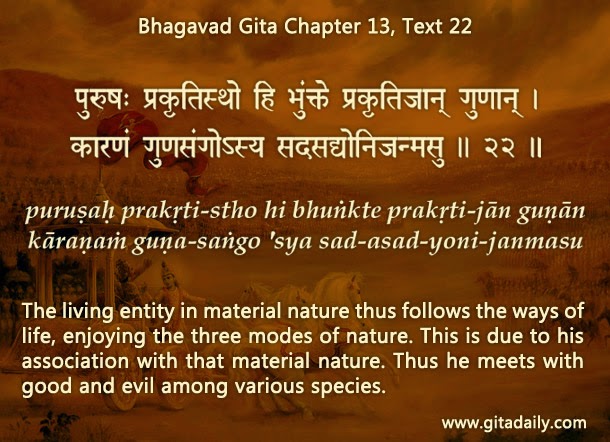
Though Krishna is omnipotent, he still gives all souls free will so that they can choose to love him and therein relish existence’s supreme fulfillment. After all, only free individuals can choose to love. But the souls can abuse their independence by choosing to not love Krishna but to enjoy matter instead. The Bhagavad-gita (13.22) indicates that due to such desires, the materially enamored souls get entrapped in matter. Impelled by material desires, the souls engage in evil deeds and are subjected to others’ evil actions, as per the inexorable law of karma.
Evil arises not from Krishna’s omnipotence but from the soul’s independence.
The next verse (13.23) underscores Krishna’s role in the souls’ actions: he is the sanctioner, not the ordainer. He doesn’t force or instruct or even want souls to get entangled in matter or to act destructively. When they choose to do wrong, he allows them to fulfill their desires till their karmic bank account runs out. Others may seem to be victimized by such destructive actions, but the victims actually reap the results of their own past karma.
Though the souls have got themselves into this arena of evil, Krishna is too compassionate to abandon them here. He accompanies them as the Supersoul in their hearts and guides them towards his loving devotion, which is the way out of all evil. Devotion empowers them to curb and counter the evil within them – their tendency to misuse their independence. It also enables them to tolerate and transcend the inevitable evil that may befall them due to their past karma. And most importantly it takes them entirely beyond the arena of evil, the material existence, to Krishna’s all-good eternal abode.


Sunday, 14 September 2014

To see life’s positive side, understand what life is and what its positive side is

Some people find the Bhagavad-gita pessimistic: “Why harp on life’s problems? Why not see its positive side?”
Actually, the Gita doesn’t harp on life’s problems – it mentions them just for impelling us to redirect our heart to life’s positive side.
To that end, Gita wisdom expands our conceptions of life and its positive side. Life, it informs us, is not restricted to a brief and brittle existence between the starting point of birth and the ending point of death. Life extends infinitely both into the past and the future, for what lives is the soul and the soul lives eternally. Each one of us is an eternal soul, beyond our perishable body.
Life is not restricted to a brief and brittle existence between the starting point of birth and the ending point of death.
And life’s positive side is not restricted to the occasional and ephemeral pleasures available at the material level. Life’s actual positive side is the life of the soul proper – the life of eternal ecstatic loving reciprocations between the soul and the all-attractive Supreme Person, Krishna, in his supreme abode.
With this expanded understanding, let’s look at the most quoted Gita verse about the miseries of material existence (08.15). Though it states that this world is miserable and temporary, its essential message is eminently positive: devotion to Krishna takes us to an eternal abode beyond this world. The same spirit runs throughout the Gita: far from harping on the world’s misery, it mentions misery as something that is transcended bybhakti-yoga.
And the positivity of bhakti is not restricted to the attainment of the next world –it encompasses this world too, for bhakti enables us to dovetail our worldly activities in devotional service and therein find spiritual fulfillment.
If we can be perceptive enough to see beyond the Gita’sincidental pessimism to its essential optimism, then we can relish life’s positive side eternally.


Thursday, 11 September 2014

Krishna is disinterested, but not uninterested by Chaitanya Charan Das Based on Bhagavad Gita

Disinterested refers to neutrality, a lack of partisanship, whereas uninterested refers to apathy, a lack of concern.
Krishna is disinterested in the sense that he is not partial to anyone. He is the overseer of the world and he acts as a neutral judge giving people the karmic due for their actions. He doesn’t have any vested interests in promoting anyone or demoting anyone. Whenever people are promoted or demoted, that’s due to their own karmic actions. The Bhagavad-gita (09.09) declares the disinterestedness of Krishna in the material management of the universe.
Krishna’s interest is not that of an over-vigilant overseer out to catch people doing wrong – his interest is that of a tireless parent striving for the return of his lost children
Yet the same Gita later (09.29), while reiterating Krishna’s disinterestedness, also stresses his special interest in his devotees. He is so concerned about them that it is as if they are one in love: he is present in their heart and they in his.
Significantly, Krishna’s interest is not limited to his devotees alone. He is interested, immensely interested, in all living beings. Why else would he accompany them as the indwelling Supersoul – and accompany them lifetime after lifetime in their journeys through miserable material existence? His interest is not that of an over-vigilant overseer out to catch people doing wrong – his interest is that of a tireless parent striving for the return of his lost children. He doesn’t just await, but accompanies, the prodigal son.
Through his indwelling presence, he acts as a concerned coach who prompts us towards our ultimate well-being through conscience, intelligence and inspiration. Even when we remain apathetic towards him, lifetime after lifetime, he never becomes apathetic towards us. Indeed, who can be more interested in us than him?
By meditating on his interest in us, we can motivate ourselves to take interest in him – to understand his message, reciprocate with his love and thereby attain a life of eternal happiness with him.


Tuesday, 9 September 2014

Krishna is not an explanation for the unexplainable – he is the explanation for explanability

Some people conceive of God as an explanatory alternative to science: “There’s so much about the world that science can’t explain; we need God to explain those things.”
While such a conception of God may sometimes serve to highlight the limitations of science, it unnecessarily restricts his jurisdiction to the scientifically unexplainable. And if future advances in science explain the currently unexplainable, then the arena for God’s jurisdiction gets reduced, leading to what is know as the God-of-the-gaps fallacy.
Krishna is not the God-of-the-gaps; he is the God due to whom the gaps are fillable
Gita wisdom doesn’t entertain such a fallacious conception of God. The Bhagavad-gita (09.10) indicates that Krishna is the overseer of nature, implying thereby that he is the reason for the order present in nature. He is the God-of-everything, not the God-of-the-gaps. He is the reason that the gaps in our knowledge are fillable. If the universe were not guided by a supreme intelligence, why should it have any order at all? Why should its behavior have any explanation? Why should we have rational minds capable of deciphering those explanations?
Thus, God is not an explanatory alternative to science; he is the explanatory foundation, the raison d’ĂȘtre for all explanations.

Sometimes wisdom-traditions use the immense and inconceivable complexity of the universe as a pointer to God. But such pointers underscore primarily his intelligence, not his existence. If the order underlying the universe is so complex that it even the best brains in the universe require years, decades and even centuries to grasp that order, then it underscores how super-intelligent the brain of the order-maker must be. Such an acknowledgement of God’s glory doesn’t deny the possibility of future scientific research explaining what is currently unexplainable. If and when such explanations do come up, they won’t demonstrate his non- existence; rather, they would demonstrate his intelligence.

Friday, 5 September 2014

Lust de-spiritualizes the subject and dehumanizes the object by Chaitanya Charan Das Based on Bhagavad Gita

When the culture depicts lust as the expressway to enjoyment, how can we understand the Bhagavad-gita’s declaration (03.37) that lust is the enemy of the world?
Let’s consider two ways in which lust acts inimically.
 Lust de-spiritualizes the subject: People who become captivated by lust misidentify with their physical body and lose all awareness of their spiritual side. Lust de-spiritualizes its subjects not just in their conceptions, but also in their actions. Being infatuated by lust, people act in anti-spiritual and even immoral if not illegal ways, that wreck their spiritual prospects. No wonder the Gita (16.21), metaphorically speaking, deems lust as the destroyer of the soul.
 Lust dehumanizes the object: Lust makes its objects, the people who attract their lust-powered attention, seem not persons for reciprocation, but mere playthings for domination and gratification. Unfortunately, such dehumanization is accelerated and aggravated by abuse of technology. TV and the Internet present a parade of electronically enhanced forms that invite visual consumption and exploitation by lust-driven viewers. And in especially perverse depictions, human beings are reduced to inflated dolls that can be twisted and pierced and battered as per one’s fancies. As the mental is often the impeller of the physical, some depraved people re-enact in real life such gory perversities on hapless victims. Indeed, the regular news of reprehensible sexual abuses vindicates the Gita’s verdict about lust.

Of course, lust channelized along dharmic guidelines can be an integral part of a spiritually progressive life. But what brings the spiritualization and the progress is not lust per se, but dharma. And the dharma that can best spiritualize us and sensitize us to others is the topmost dharma of love for Krishna, for it undercuts the lure of lust by granting higher devotional happiness.

Thursday, 4 September 2014

Fame is the pathway to not satisfaction but dissatisfaction

Fame is life’s driving purpose for many : “I would do anything to be the cynosure of all eyes, as are sportstars.”
Little do they realize that public attention hardly ever translates into personal satisfaction. Sportstars who are regularly greeted by cheers whenever they arrive in a sporting arena soon get used to it – the high coming from the cheer fades with time. To get a high, their fans need to do something extra, give some special applause. And to earn such applause, they need to deliver special performances.
But none of us, not even geniuses, are perfect. Even the most talented sportstars can’t perform superlatively all the time and so don’t get special applause.
And when the sportstars fail, as is inevitable in due course of time, the audience’s frustration bursts forth as boos and jeers. The sportstars already depressed by their poor performance end up feeling battered by the audience’s opprobrium.
The Bhagavad-gita underscores this discomforting reality about fame when it declares (02.34) that for those who have been honored, dishonor is worse than death.
Gita wisdom offers us a purpose higher than fame to live for. That purpose is love – , spiritual love for Krishna that can stay with us forever. We are at our core souls who hunger and thirst for love. Not knowing how to fulfill this longing, we try to substitute it by the titillation that fame provides.

When we pursue a life of loving service to Krishna, we may even get fame as a byproduct. Or we may not get fame, depending on what Krishna sees as best for our all-round growth. But we will definitely get what attracted us to fame in the first place: the hope for attention, affection and satisfaction – all of which are completely fulfilled in a loving relationship with Krishna.

Wednesday, 3 September 2014

Leave temptation – and don’t leave a forwarding address

When troublesome stalkers harass people repeatedly, they may decide to flee. For this strategy to succeed, they need to leave without leaving a forwarding address; otherwise, the stalkers will soon be snapping at their heels.
Similarly, when we find ourselves harassed and stalked by temptation, we need to flee to save ourselves. Fleeing usually means either getting ourselves physically away from the tempting circumstance or at least getting our thoughts away from the tempting stimuli. While retreating though, we frequently leave a forwarding address for the temptation. How? By continuing to entertain the temptation at the back of our mind – by refusing it with not “No”, but just “Not now.”
We often refuse temptation merely by the desire to preserve a respectable public profile or such external considerations – not by inner conviction.
Why are we half-hearted in our refusal?
Because we are often prompted merely by the desire to preserve a respectable public profile or such external considerations – not by inner conviction. Staying open for future opportunities to indulge privately is like leaving a clearly visible forwarding address for temptation. No wonder it keeps stalking us even after our refusal.
To stop the stalking, we need to leave for temptation no forwarding address. That is, we need to reject it wholeheartedly with the determined conviction that sensual pleasures are ultimately futile and that the devotional joys awaiting us are far more fulfilling. We can gain such determined conviction firstly by strengthening our intelligence through serious scriptural study and secondly by enriching ourselves through devotional activities such as prayer and meditation. Then our rejection of temptation will be clear and unequivocal. Pertinently, the Gita (06.24) urges us to reject distracting desires without making any exceptions.

A devotionally purposeful rejection of temptation founded on a wholehearted inner embrace of Krishna will propel us rapidly on the way to him, eventually taking us forever beyond the harassment of temptation.