Thursday, 21 May 2015

Chaitanya Charan Das Based on Bhagavad Gita Chapter 02.

To think we are beyond danger is the greatest danger by Chaitanya Charan Das Based on Bhagavad Gita Chapter 02.
When a boat is at sea, the danger of a storm exists constantly. If the boater becomes lulled into complacency by, say, the calm waters around, the next storm may turn out to be disastrous.
The Bhagavad-gita (02.67) warns that desire can sweep away our intelligence just as a wind can sweep away a boat. Significantly, whereas the boat doesn’t invite a stormy wind, we often invite a stormy desire. How? By contemplating carelessly on tempting sense objects, thereby letting our imagination expand a passing attraction into a consuming obsession (02.62-63).
When we successfully resist temptation a few times and when the water of our consciousness stays calm for some time, we may start thinking that we have become so advanced as to be beyond temptation.
To avoid such contemplation, we need to be alert to where our senses are wandering and check them when they go in unwholesome directions. We will cultivate alertness when we know that we are always in danger. But when we successfully resist temptation a few times and when the water of our consciousness stays calm for some time, we may start thinking that we have become so advanced as to be beyond temptation. Due to such complacency, we won’t stay alert and will unwittingly let our mind contemplate some alluring sense object that comes in our perception. That contemplation generates a forceful craving which sweeps away our intelligence and impels us to self-destruction.
To prevent danger from thus degenerating into disaster, we should never think that we are beyond danger. Won’t thinking constantly of possible danger make us paranoid? Not if we practice bhakti-yoga with its positive focus on remembering and serving Krishna. In bhakti-yoga, we focus on Krishna, not danger. But when lethargy or apathy or anything else makes us lax, we can use our awareness of danger for steeling our resolve to stay devotionally focused. Such absorption will guarantee not only our present safety but also our progress towards the supremely safe shore of Krishna’s eternal abode.


Monday, 18 May 2015

Chaitanya Charan Das Based on Bhagavad Gita Chapter 15

Rift with God makes us drift with the mind by ChaitanyaCharan Das Based on Bhagavad Gita Chapter 15
We are pleasure-seeking beings. And we are intrinsically the eternal parts of Krishna, as the Bhagavad-gita (15.07) states. Because Krishna is the all-attractive reservoir of all pleasure, we can best fulfill our longing for pleasure by connecting lovingly with him.
But when some things don’t go according to our plan, we may develop a rift with Krishna. We may resent him, slacken our devotional service and start looking elsewhere for pleasure. And the mind stands ever ready with numerous suggestions.
Because by a gradual drift, the mind has taken us far away from our conscience and intelligence, we end up viewing depraved pleasures as not just acceptable but even irresistible.
Knowing that our intelligence and conscience are not yet numbed, the mind usually doesn’t suggest gross temptations first. It often begins with saattvika pleasure-sources that seem cultured and refined, even if not Krishna-connected. As we settle into such godless happiness, it then presents raajasika temptations that promise more visible and tangible pleasure. And once we indulge in them, it presents taamasika indulgences that we wouldn’t even have considered earlier. But now because by a gradual drift, the mind has taken us far away from our conscience and intelligence, we end up viewing depraved pleasures as not just acceptable but even irresistible. Thus we sink to shocking lows in our vain search for pleasure. The search is vain because all substitutes for Krishna being ephemeral and peripheral to our spiritual essence leave us dissatisfied.

The best way to avoid being misled by the mind is to immediately repair any rift with Krishna or, better still, prevent it entirely. How? By reminding ourselves that even if specific things don’t work out in this world, Krishna as the otherworldly source of shelter and satisfaction remains always available to us through his holy name, Deity, scripture and other such divine manifestations. By absorbing ourselves in the manifestation that we find most relishable, we can, even amidst life’s ups and downs, stay always connected with him, safe and satisfied.

Friday, 15 May 2015

Chaitanya Charan Das Based on Bhagavad Gita Chapter 18

Renunciation centers not on running away from the worlds but running towards God by Chaitanya Charan Das Based on Bhagavad Gita Chapter 18
Some people say, “Those who can’t face the world’s problems run away from them by becoming renunciates.”
Sadly, it’s true that some people do take to renunciation for escaping from the world’s problems. However, the Bhagavad-gita doesn’t commend or even condone this kind of renunciation. It (18.08) mentions those who find work too troublesome for their body and try to evade that trouble by joining the renounced order. Declaring that such renunciation is in the mode of passion, it warns that these renunciates won’t get the fruits of renunciation.
The fruit of renunciation is the same as the ultimate fruit of life: everlasting spiritual happiness. We are at our core souls and are meant to relish a life of eternal love with the all-attractive supreme soul Krishna. The various orders of life – be they engaged or renounced – are meant to help us move towards Krishna.
Devotional service helps us realize that Krishna is more important than everything else in the world and that the happiness of loving and serving him is life’s only true happiness.
The best way to progress towards Krishna is bhakti-yoga. Devotional service helps us realize that Krishna is more important than everything else in the world and that the happiness of loving and serving him is life’s only true happiness. Bhakti being inclusive can be practiced in all orders of life (ashrams), but the focus on practicing bhakti can be much greater in the renounced order. Therein, most worldly entanglements get minimized, so seekers can run as fast as possible towards Krishna. However, if renunciates focus not on attaining Krishna, but on escaping from the world, they defeat the purpose of the renounced order.
Significantly, the renounced order serves a purpose greater than just facilitating the rapid progress of renunciates. Genuine renunciates who wholeheartedly live for seeking Krishna, savoring Krishna and sharing Krishna become living examples for everyone in society, reminding them that Krishna is for real and is life’s ultimate goal.


Thursday, 14 May 2015

Chaitanya Charan Das Based on Bhagavad Gita Chapter 18

Surrendering is not rejection of the intelligence, but its perfection by Chaitanya Charan Das Based on Bhagavad Gita Chapter 18
Some people perceive devotion as anti-intellectual, as an abandonment of the intelligence for an abject surrender to God.
However, that is not the kind of devotion that the Bhagavad-gita espouses. At the Gita’s start (02.07) Arjuna surrenders to Krishna, yet Krishna doesn’t treat this surrender as a license for neglecting Arjuna’s intellectual concerns. Far from it, Krishna throughout the Gita strives to educate and elevate Arjuna’s intelligence. He patiently and cogently answers Arjuna’s many questions, even when they border on the challenging (04.04-05). And towards the Gita’s end (18.72), he specifically asks Arjuna whether his illusion and ignorance have been dispelled. The Gita commentator Vishvanath Chakravarti Thakura explains the subtext of Krishna’s enquiry: being concerned that Arjuna understand things properly, Krishna is willing to repeat his message partially or even fully. Such vigilant concern clearly demonstrates that the supreme teacher considers his student’s intelligence important, not redundant.
Philosophically speaking, surrendering doesn’t mean rejecting the intelligence, but integrating it. Such integration is evident in Arjuna’s response (18.73), wherein he states that his doubts have been resolved and his composure restored – and being thus intellectually convinced he is ready to do Krishna’s will.
No doubt, when we surrender to Krishna, we accept that some aspects of his glories and his energies are inconceivable. However, we accept this not by rejecting the intelligence, but by intelligently recognizing that Krishna is greater than our intelligence, which, like us, is finite. So it is only intelligent for us to admit that Krishna will have features that our intelligence won’t be able to figure out. Such an admission is not anti-intellectual, but is trans-intellectual.
Ultimately, devotional surrender catapults us to beyond intelligence’s reach to the summit of transcendence: eternal spiritual love for Krishna. And harmonizing our intelligence with that ascent is the intelligence’s perfection.


Wednesday, 13 May 2015

Act proactively, not reactively by Chaitanya Charan Das Based on Bhagavad Gita Chapter 14

Acting proactively means acting according to our principles and purposes in both actions we initiate as well as the ways we respond to events. Acting reactively means to let our actions be determined by our mind’s fancies of the world’s fancies.
To understand the difference, consider the metaphor of boaters facing a storm. If boaters have a destination they are determined to reach, then even if the storm constrains them to change course, they will as soon as the storm abates get back on course. If, on the other hand, they have no clear destination or no determination to reach there, they will drift whichever way the winds push them.
Being fully proactive requires rising beyond the influence of the modes that impel us towards reactive behavior, acting as if programmed by our conditionings.
Gita wisdom compares the material world to an ocean, wherein storms of desires can drive us off-course at any moment. Reactive people are driven by nature’s mode of passion, wherein, as the Bhagavad-gita (14.12) indicates, insatiable desires keep them flitting from one thing to the next. People in ignorance are even more reactive, with their reactions characterized by confusion, inaction and overall illusion (14.13).
People in goodness are proactive – the Gita (14.11) indicates that their senses are illumined with knowledge, implying that they know how to thoughtfully process the inputs coming from their senses and intelligently respond to them. Of course, being fully proactive requires rising beyond the influence of the modes that impel us towards reactive behavior, acting as if programmed by our conditionings. So only those who are transcendental, who can see the actions, perceptions and emotions triggered in the world and in the mind as the result of the modes (14.19), can be fully proactive.
Such a vision centers not on the rejection of the whole world and its stimuli as illusion but on learning to love the transcendental Lord and letting the desire to serve him shape all our choices.


Tuesday, 12 May 2015

Chaitanya Charan Das Based on Bhagavad Gita Chapter 02

While knowledge curbs the senses, devotion conquers the senses by Chaitanya Charan Das Based on Bhagavad Gita Chapter 02
Knowledge, specifically spiritual knowledge, helps us understand our spiritual identity and thereby recognize the necessity of controlling the senses that drag us towards material enjoyment and away from self-realization.
Yet spiritual knowledge alone is not enough. It tells us why sense control is good for us, but that doesn’t necessarily make sense control feel good. And we can’t go very far on the spiritual path if our feelings are constantly tripping us. That’s what happens when we base our spiritual journey on knowledge alone. The Bhagavad-gita (02.60) states that even knowledgeable seekers endeavoring for sense control are dragged down by the impetuous senses.
That’s why Gita wisdom goes beyond knowledge to devotion as the key for spiritual progress and success. Devotion connects us with Krishna, the all-attractive reservoir of all pleasure, and thus enables us to relish higher spiritual happiness that makes checking the lure of sensual pleasures much easier. Bhakti-yoga is sensory spirituality – it offers the senses satisfying spiritual engagement as in, say, beholding Krishna’s beautiful form, hearing his relishable pastimes and singing his sweet kirtans.
Significantly, while going beyond knowledge to devotion, the Gita doesn’t reject knowledge, but incorporates it within devotion. That knowledge is integral to devotion which guides us to redirect our heart towards Krishna and to spiritualize our actions in this world. The Gita provides us such knowledge. By studying it, we can curb the senses. And by devotionally focusing on Krishna, we can conquer the senses. The Gita (02.61) assures us that if we curb our senses (samyamya) and fix our consciousness on Krishna, we will be able to conquer the senses (vasha). The higher taste from devotion will replace the senses’ greed to enjoy sense objects with the longing to experience Krishna. The senses energized by this devotional longing will accelerate, not decelerate, our spiritual progress.


Monday, 11 May 2015

Chaitanya Charan Das Based on Bhagavad Gita Chapter 15

Comprehension comes by the integration of visual perception with intellectual education by Chaitanya Charan Das Based on Bhagavad GitaChapter 15
We usually consider our eyes as reliable sources of knowledge. In court cases, eyewitness testimonies are deemed strong evidence. Yet valuable as visual perception is, it can be misleading when the action being observed is complex and needs intellectual background to comprehend.
Suppose an eyewitness observed a doctor giving an injection to a patient. If the eyewitness were a child, he or she may see the doctor negatively, as the giver of a painful prick. A more mature observer would see the injection positively, as part of a treatment. But that may not be the case – nowadays with medically assisted suicides on the rise, that injection may well be lethal. Worse still, an unprincipled doctor bribed by greedy relatives might have administered that fatal injection to an unsuspecting patient.
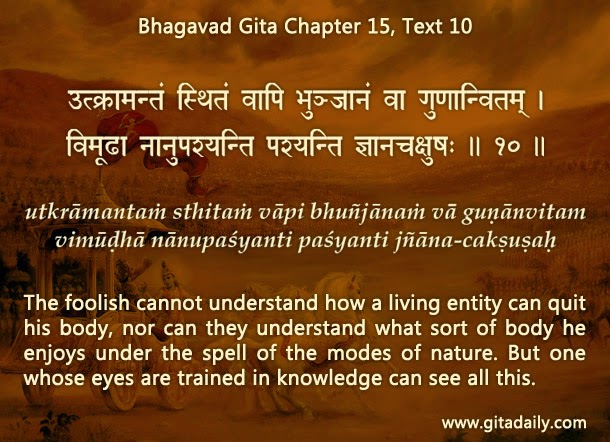
The Bhagavad-gita (15.10) exhorts us to understand the soul not by visual perception alone, but by the integration of visual perception with intellectual education.
Clearly, in complex cases, eyewitness testimony doesn’t tell much. Far more complex than medical matters are spiritual subjects. Naturally therefore the Bhagavad-gita (15.10) exhorts us to understand the soul not by visual perception alone, but by the integration of visual perception with intellectual education. The Gita uses an apt compound word: jnana-chakshushah (eyes of knowledge). When we educate our vision with spiritual knowledge, we see the consciousness that pervades the body as persuasive evidence of a non-material soul. After all, matter that is the building block of the body is unconscious, so it can’t be the source of consciousness.
Gita wisdom offers much more than this inferential comprehension of the soul – it also offers processes for accessing non-material modes of perception. If we follow the process of yoga, especially bhakti-yoga, for activating our latent capacity for spiritual perception, we gain increasing intellectual comprehension and spiritual realization. Being inspired by these insights, we march steadily on the yogic path till we perceive the spiritual realm in its full glory.